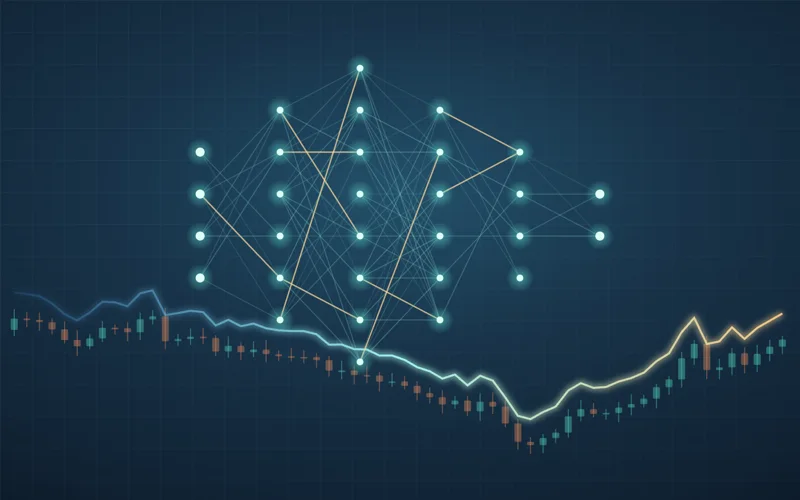
Most trading bots follow fixed rules: the condition is met, the order goes out. In the Wolf and Mole strategies there is one more step between the signal and the order: a machine-learning model that decides whether this trade is worth entering. Here is how it works, without formulas or technical details.
What the AI filter does
Every Wolf and Mole trading bot first finds a signal by the rules of its strategy: the price has moved too far from its expected range, and the bot is ready to enter against that move. Then the model reads the latest candles of the pair and forecasts where the price is most likely to go next. If the forecast confirms the signal with a margin, the bot enters. If the forecast is weak or points the other way, the entry is skipped.
The model does not set the position size, move stops or close trades. Order levels, exits and risk are defined by the strategy rules and are the same for every pair. The AI does one job only: it filters out entries that historically had little chance.
What the model learned from
- History from September 2019 to May 2026, almost seven years of the altcoin market: bull and bear phases, crashes, long sideways stretches.
- 137 USDT perpetual pairs on Binance, from BTC and ETH to young altcoins. The wider the sample, the less the model adapts to the behaviour of a single coin.
- Four timeframes: 6h, 8h, 12h and 1d. Separate models for the shorter timeframes and for daily candles.
- Only candles and indicators derived from them: the model does not read news or social media and knows nothing that is not on the chart.
Training ended on May 10, 2026. The model has not seen anything that happened after that date.
Why the statistics start in May 2026
A model checked on the same data it learned from almost always looks better than it will trade. That is why the EDVI catalog shows Wolf and Mole statistics only from May 10, 2026, the moment training ended. It is an honest period: the model sees these candles for the first time, just as it will see the market tomorrow.
Wolf: a progressive filtering model
Wolf is 178 trading bots on 46 pairs, one bot per pair and timeframe, each trading long and short. One model works on 6h, 8h and 12h, another on daily candles. Wolf's filter threshold is moderate: the bot enters when the forecast confirms the signal by at least 0.2-0.5% in the right direction.
Wolf statistics from May 10 to November 6, 2026 with a ×1 risk multiplier:
- 3,689 closed trades, 77.7% of them profitable;
- result +19.5% on a fixed deposit;
- maximum drawdown on closed trades -2.5%, including open positions -5.9%.
Mole: the same strategy, a more aggressive model
Mole uses the same entry and exit logic, the same 46 pairs and the same timeframes, 184 trading bots in total. The difference is the model: on 6h, 8h and 12h Mole has its own, more aggressive model that lets more entries through. On daily candles the model is the same as Wolf's.
Mole statistics from May 10 to November 5, 2026 with a ×1 risk multiplier:
- 5,463 closed trades, almost one and a half times more than Wolf; 83.8% profitable;
- result +48.4% on a fixed deposit;
- maximum drawdown on closed trades -1.9%, including open positions -4.7%.
More trades also means more positions open at the same time. If you connect Mole with a large deposit or a high risk multiplier, watch the total load on your account, not just the risk of one trade.
How to choose
- Wolf suits you if you want a calmer pace: fewer trades, stricter selection.
- Mole suits you if you accept more positions in exchange for more frequent entries.
- Bots of both strategies can be combined in My assembly, each with its own risk multiplier.
What to keep in mind
Strategy statistics are calculated on historical Binance candles net of exchange fees, on a fixed deposit with a ×1 multiplier. This is not the result of your account and not a promise of returns: the market can behave differently from any past period, and real trades are filled with slippage and funding. Current figures are always on the strategies page, and the risks are described in Responsibility.